A flyer has about one and a half seconds to earn a second look. Size is the first thing the reader processes — before the headline, before the picture — because it tells them how much work the thing is going to be. Pick the size that matches the amount you actually have to say, and the rest of the design gets easier.
| Size | Cut from | Reads as | Typical use |
|---|---|---|---|
| 4in × 6in | Postcard | One offer, one image | Mailbox drops, counter cards |
| 5.5in × 8.5in | Half letter | Headline plus a short list | Handouts, menu inserts, door hangers |
| 8.5in × 11in | Letter | A full page of detail | Price lists, service menus, event programmes |
| 8.5in × 14in | Legal | Long list, unusual shape | Real estate features, tear-off sheets |
| 11in × 17in | Tabloid | A small poster | Window bills, event posters, folded to letter |
The five sizes, and what each one is honestly for
4in × 6in is a postcard. It holds one offer, one image and a way to get in touch, and that is the whole point: there is no room to hedge. It is the cheapest size to print and the cheapest to mail. If you cannot fit your message on a 4 × 6, your message is not finished.
5.5in × 8.5in is half a letter sheet and the most useful size in the list. Big enough for a headline, a short list of services and a price, small enough to feel like a handout rather than a document. It also slips under a wiper blade, into a shopping bag and through a mail slot without folding.
8.5in × 11in is a full letter page. Order it when you genuinely have a page of information — a seasonal price list, a menu, a schedule. Order it by mistake and you get a sheet with a lot of empty space that reads as a form.
8.5in × 14in is legal size, and its whole value is that it is unusual. In a stack of letter-sized paper it sticks out by three inches. Real estate feature sheets use it for exactly that reason.
11in × 17in is a small poster. Folded once it becomes a letter-sized four-page piece, which is the cheapest way to get a multi-page feel without going to a saddle-stitched booklet.
The part that costs money later: postal size bands
If you are distributing through Canada Post Neighbourhood Mail, the size band you land in changes the per-piece rate for the whole drop. This catches people out because it is decided at design time, not at mail time.
| Band | Max dimensions | Max weight | Note |
|---|---|---|---|
| Standard | 140mm × 245mm × 5mm | 50g | Cheapest band. A 5.5in × 8.5in flyer fits. |
| Oversize | 300mm × 380mm × 20mm | 500g | 8.5in × 11in and 11in × 17in folded land here. |
The practical consequence: a 5.5in × 8.5in flyer fits the Standard band. An 8.5in × 11in does not, unless you fold it. On a 10,000-piece drop that difference is not small, and it is entirely free to design around if you know about it before the file is built.
Confirm the current rates and dimensions with Canada Post before you commit — the bands are stable but the rates move, and we would rather you checked than took our word for it.
Stock: the decision most people skip
Flyer paper is quoted in pounds, and the number refers to the weight of 500 parent sheets, which is why the scale feels arbitrary until you have handled it.
- 80lb gloss text is the standard flyer weight. It has a sheen, it takes photographs well, and it is light enough to mail cheaply. This is the default and it is the right default.
- 100lb gloss text is noticeably more substantial without becoming card. Worth it for anything that has to sit on a counter rather than go straight into a bag.
- 100lb matte text kills the glare. If your flyer is mostly text — a price list, a schedule — matte is easier to read under fluorescent light.
- 14pt card turns the flyer into a rack card. Use it when the piece has to stand up in a holder or survive being handled repeatedly.
Coated stock resists finger marks; uncoated takes pen. If your flyer has a space where somebody writes an appointment time, do not print it on gloss.
Two-sided is almost always right
The second side costs a fraction of the first — the sheet is already through the press, already trimmed, already paid for. Leaving it blank saves very little and gives up half your space.
What goes on the back: the detail. The front carries the offer and one image. The back carries the service list, the coverage area, the hours, the address and the QR code. That split works because it matches how people actually read a flyer — front at arm's length, back only if the front earned it.
Bleed, and the one mistake we see most
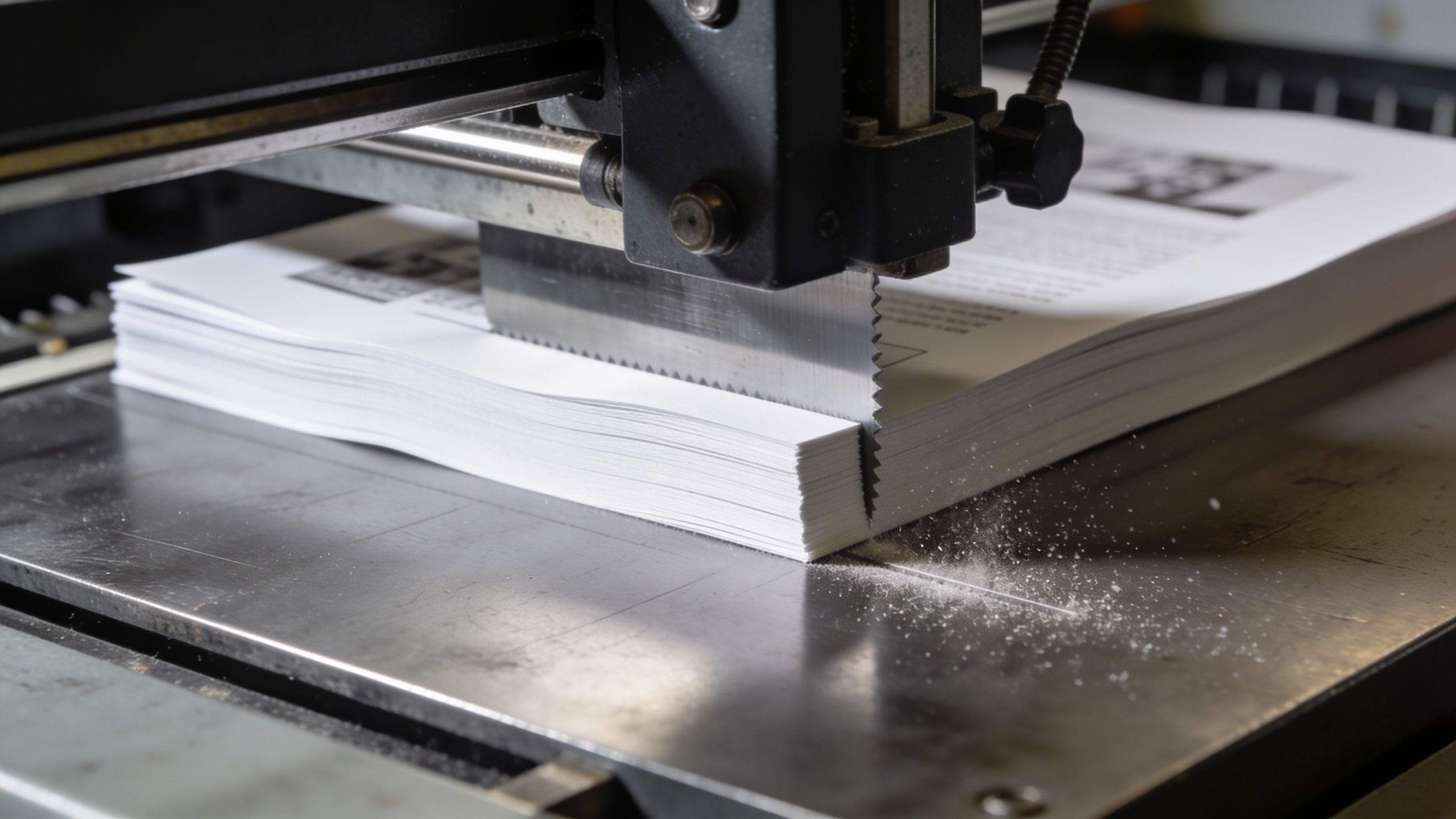
Anything that touches the edge of the sheet has to extend 0.125in past it, and anything you need to keep has to sit 0.25in inside the trim. Flyers get trimmed in lifts of several hundred, and the blade moves fractionally through the stack. A phone number set 2mm from the edge will survive on the top sheet and lose a digit on the bottom one.
We have written the file rules out properly in setting up print files.
Ordering flyers in the GTA
Most flyer runs leave the shop in three to five business days after artwork approval. Rush work is possible — ask when you send the job, not after.
- Flyer printing in Mississauga — sizes, stocks and local turnaround
- Commercial printing and signage — the full print catalogue including postcards, booklets and rack cards
- Business cards in Mississauga — usually ordered in the same job, and cheaper together
- Packages and pricing — the Momentum Kit includes 1,000 flyers on 100lb gloss
Not sure which size fits what you have to say? Send us the copy and we will tell you which one it wants to be.