Nobody asks what a business card costs. They ask what their business card costs, and the honest answer is that four decisions set the number: how many you order, what you print them on, what goes over the top, and whether the back is doing any work. Everything else is noise.
Here is the whole picture, and then the reasoning underneath it.
| Run | 14pt matte | 16pt soft-touch | 16pt soft-touch + spot UV |
|---|---|---|---|
| 100 | $45 – $65 | $70 – $95 | $110 – $145 |
| 250 | $60 – $85 | $95 – $130 | $150 – $195 |
| 500 | $80 – $115 | $130 – $175 | $195 – $260 |
| 1,000 | $110 – $155 | $175 – $240 | $260 – $340 |
| 2,500 | $190 – $265 | $300 – $410 | $430 – $565 |
| 5,000 | $300 – $420 | $470 – $640 | $650 – $860 |
Why 250 cards cost nearly as much as 500
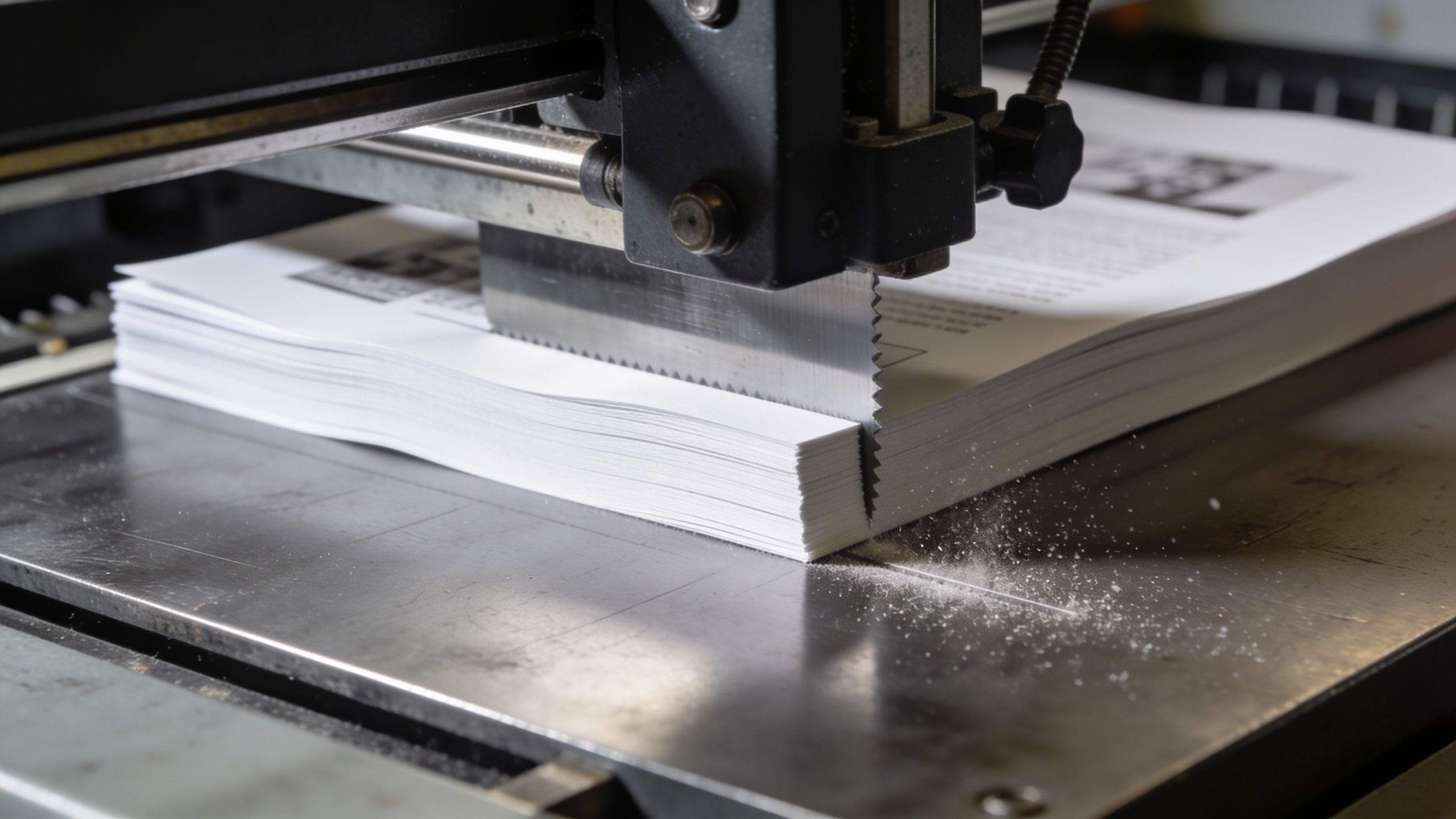
Most of the money in a short run is spent before a single card is printed. Artwork gets preflighted, the file is imposed — laid out several-up on a larger parent sheet — the press or press-equivalent is set to the stock, colour is brought to target against a proof, and then the stack is trimmed on a guillotine, which is a fixed number of cuts whether the lift is one inch or four.
That work is identical for 250 cards and 500. The only thing that changes is the paper, which on a 16pt card is a few cents a sheet. So the second 250 costs you almost nothing, which is why the per-card price falls off a cliff between the smallest runs and the middle of the table.
The practical rule: if you are ordering 100, order 250. If you are ordering 250 and your details are stable, order 500. The exception is a phone number or address you expect to change, in which case the cheap box is the one you throw out.
What the stock actually changes
Card thickness is measured in points — thousandths of an inch. A 16pt card is 0.016in thick. The step from 14pt to 16pt is the one people feel; the step from 16pt to 32pt is the one they comment on.
| Stock | Thickness | Feels like | Best for |
|---|---|---|---|
| 14pt matte | 0.014in / 356µm | A firm supermarket loyalty card | High-volume handouts, tight budgets |
| 16pt C2S | 0.016in / 406µm | The default 'good card' | Most businesses, most of the time |
| 16pt soft-touch | 0.016in + laminate | Suede, slightly warm | Trades and services who hand cards over in person |
| 32pt duplex | 0.032in / 813µm | A thin coaster, visible colour seam | One-off impressions: studios, high-ticket sales |
Soft-touch laminate is the single best-value upgrade on this list. It is a thin matte film applied over the printed sheet, and it changes the card from something that feels like paper to something that feels like an object. It also protects the surface: an uncoated card that lives in a wallet for three weeks looks like it has lived in a wallet for three weeks.
The trade-off is that you cannot write on soft-touch with a normal pen. If your trade involves writing a quote or an appointment on the back of the card at the door, ask for uncoated stock or a spot of uncoated left in the laminate.
Finishes worth paying for, and one that usually is not
Spot UV is a raised gloss varnish applied to part of the card only — a logo, a rule, a pattern. Against soft-touch it is genuinely striking, because the eye reads matte and gloss side by side. It needs a second file: a mask where solid black marks where the varnish goes, white marks where it does not.
Foil looks expensive because it is. It adds a die and a foiling pass, and on runs under 1,000 it can double the job.
Rounded corners cost very little and change the object more than people expect. They also stop the corners bruising in a pocket.
Full-bleed colour on both sides is the one that often is not worth it. A saturated back with no information on it doubles your ink coverage and gives the reader nothing. A back with your service list, your hours, or a QR code that goes somewhere useful earns its place. A back that is just your brand colour does not.
Digital or offset — and where the line sits
Below roughly 1,000 cards, digital printing wins on cost because there is no plate to make. Above it, offset starts to pull ahead, and by 5,000 it is not close: plates are a one-time cost that gets spread across the run, and the per-sheet cost of offset is far lower.
Digital has caught up on quality for most work. Where offset still wins is large solid areas — a deep, even flood of one colour across the whole card — and exact spot-colour matching against a Pantone reference. If your brand lives or dies on one specific blue, say so when you send the job.
What we need from you
Send a print-ready PDF with 0.125in bleed on all four sides, 300 ppi artwork, and everything important kept 0.125in inside the trim. Fonts embedded or outlined. Built in CMYK, not RGB — a bright RGB green that has never been printed will come back duller than your screen promised.
If any of that is unfamiliar, we have written it out properly in setting up print files. If you would rather we handled it, artwork setup is a line item, not a favour we do reluctantly.
Ordering in and around Mississauga
We print in-house at Skymark Avenue and most card runs are ready in three to five business days after artwork approval. Pickup, or delivery across the GTA.
- Business cards in Mississauga — turnaround, local pickup, and what the Meadowvale and City Centre offices tend to order
- Business cards in Brampton and in Markham — same shop, same stock, delivered
- Commercial printing and signage — the full catalogue, stocks and finishes
- Packages and pricing — cards are bundled into the Launch Kit if you are opening the doors and need a site as well
If you already know the run, the stock and the finish, send the job through and you will have a firm number back within one business day. If you do not, tell us what the card is for and we will tell you what we would order.