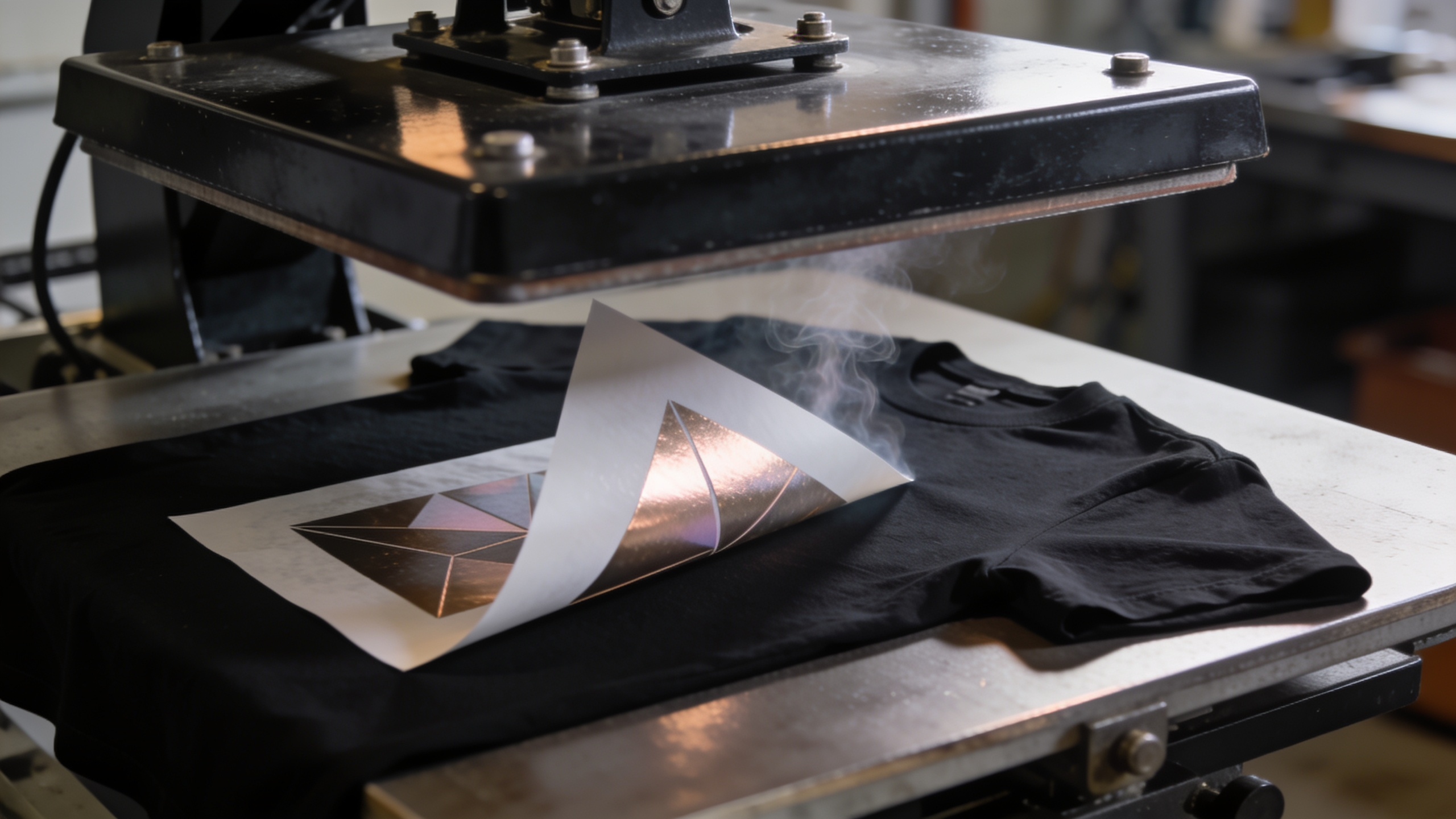
Three processes, one garment, and the right answer changes depending on how many you are ordering and what the design looks like. Here is the whole comparison in one place, then the reasoning that decides it.
| Screen printing | DTF transfer | Embroidery | |
|---|---|---|---|
| How it works | Ink pushed through a mesh stencil, one screen per colour | Design printed to film, powdered, heat-pressed | Thread stitched into the fabric |
| Colour count | Each colour is another screen and another setup | Unlimited — photos and gradients included | Limited by thread colours on the machine |
| Best run size | 48 pieces and up | 1 – 48 pieces | Any, but digitising is a one-time cost |
| Hand feel | Soft on a light print, heavier on dark garments | A thin film layer you can feel | Raised thread, no film |
| On dark garments | Needs a white underbase | Prints white as standard | Unaffected — thread is opaque |
| Wash durability | 50+ washes | 40 – 50 washes if pressed correctly | Outlives the garment |
| Fabric limits | Cotton and blends | Almost anything, including polyester | Not for thin or stretchy knits |
| Best for | Large runs of a simple mark | Small runs, photos, one-offs, samples | Polos, caps, workwear, anything that must look formal |
Screen printing
A stencil is made for each colour in the design, and ink is pushed through a fine mesh onto the garment. Every colour needs its own screen, its own setup and its own pass, which is why a one-colour print on 200 shirts is cheap and a six-colour print on twelve shirts is not.
Screen printing is still the best-looking option for a simple mark at volume. The ink sits in the fabric rather than on it, so a lightly-inked print on a light garment is barely detectable to the hand and survives washing indefinitely.
Dark garments complicate this. Ink is translucent, so printing a colour on black requires a white underbase printed first and flashed dry — an extra screen, an extra pass, and a heavier feel. It is still the right process at volume; it is just not as cheap as the light-garment version, and a quote that does not distinguish the two is guessing.
Pick it when: you are ordering 48 or more, the design is one to three flat colours, and the garments are cotton or a cotton-rich blend.
DTF — direct-to-film
The design is printed onto a clear film with pigment inks, a heat-activated adhesive powder is applied to the wet ink, the sheet is cured, and the transfer is then heat-pressed onto the garment.
The important consequence: there is no setup per colour. A photograph costs the same to press as a single-colour logo. That makes DTF the only sensible way to do small runs, one-offs, and anything with gradients or photographic detail.
It also prints white as part of the process, so dark garments need no separate underbase, and the adhesive bonds to polyester and blends that screen printing struggles with. Safety wear, performance fabrics and tri-blends are all straightforward.
The trade-off is hand feel. DTF leaves a thin film layer on the surface. On a small left-chest logo nobody notices. On a full-back print at A3, you can feel it, and it will never feel like a screen print.
Pick it when: the run is under about 48, the design has more than three colours, the garment is polyester or a blend, or you need one sample before committing.
Embroidery
Thread stitched into the fabric by a multi-head machine. Before anything is stitched, the artwork has to be digitised — converted into a stitch file that specifies path, direction, density and underlay. That is a one-time cost per design, and it is skilled work, not a file conversion.
Embroidery does not fade, does not crack and does not peel. Realistically it outlives the garment. It also reads as more formal than any print, which is the actual reason most businesses choose it: an embroidered polo looks like a uniform, a printed tee looks like merchandise.
Its limits are real. Fine detail below about 4mm turns into a blob — small text is the usual casualty. Large filled areas become heavy and stiff and take a long time to stitch, so cost scales with stitch count, not with size on paper. And thin or stretchy knits pucker: a needle repeatedly piercing a lightweight jersey distorts it.
Pick it when: the item is a polo, cap, jacket, apron or workwear; the design is a compact logo rather than a picture; and you want it to look permanent.
Where each one becomes the cheap option
| Quantity | Screen printing | DTF | Embroidery |
|---|---|---|---|
| 1 – 11 | Not viable — setup dominates | $14 – $22 each | $16 – $26 each |
| 12 – 23 | $18 – $26 each | $11 – $17 each | $13 – $20 each |
| 24 – 47 | $12 – $17 each | $9 – $14 each | $11 – $17 each |
| 48 – 99 | $8 – $12 each | $8 – $12 each | $10 – $15 each |
| 100 – 249 | $6 – $9 each | $7 – $11 each | $9 – $13 each |
| 250+ | $4 – $7 each | $6 – $10 each | $8 – $12 each |
The crossover most people care about sits around 48 pieces. Below it, DTF almost always wins because screen setup has nowhere to amortise. Above it, screen printing pulls away and keeps going. Embroidery stays relatively flat once digitising is paid for, which is why it looks expensive on twelve pieces and reasonable on two hundred.
Two things that decide more than the process
The garment. A cheap tee decorated beautifully is still a cheap tee, and it is what the wearer judges. Ring-spun cotton feels substantially better than open-end and costs a little more. For polos, a mid-weight piqué holds embroidery without puckering; a thin jersey does not.
The placement. Left chest is roughly 3.5in wide. Full front is 11–12in. Youth sizes need a smaller print or the design runs into the seams. If you are ordering a size range from YS to 3XL, expect two print sizes, and say so up front so nobody is surprised.
What we need from you
Vector artwork — AI, EPS or a PDF with live vectors — is best for screen printing and embroidery, because both need clean edges to separate or digitise. For DTF, a 300 ppi PNG with a transparent background at final print size is fine.
Tell us the garment, the colour, the size breakdown and the placement. If you are not sure which process fits, describe the job and we will tell you which one we would run and why.
Ordering decorated apparel in the GTA
Everything is decorated in-house — no brokering out, which is why we can tell you what the machine is actually doing.
- Custom apparel in Mississauga — garments carried, turnaround and local pickup
- Embroidery in Mississauga — digitising, stitch counts and what suits thread
- Custom apparel in Markham, Toronto and Oakville
- Custom apparel and workwear — the full decoration catalogue
- Packages and pricing — the Storefront Kit at $3,499 includes 25 decorated pieces for staff
Send us the job with quantities and we will come back with a real number and a recommendation.