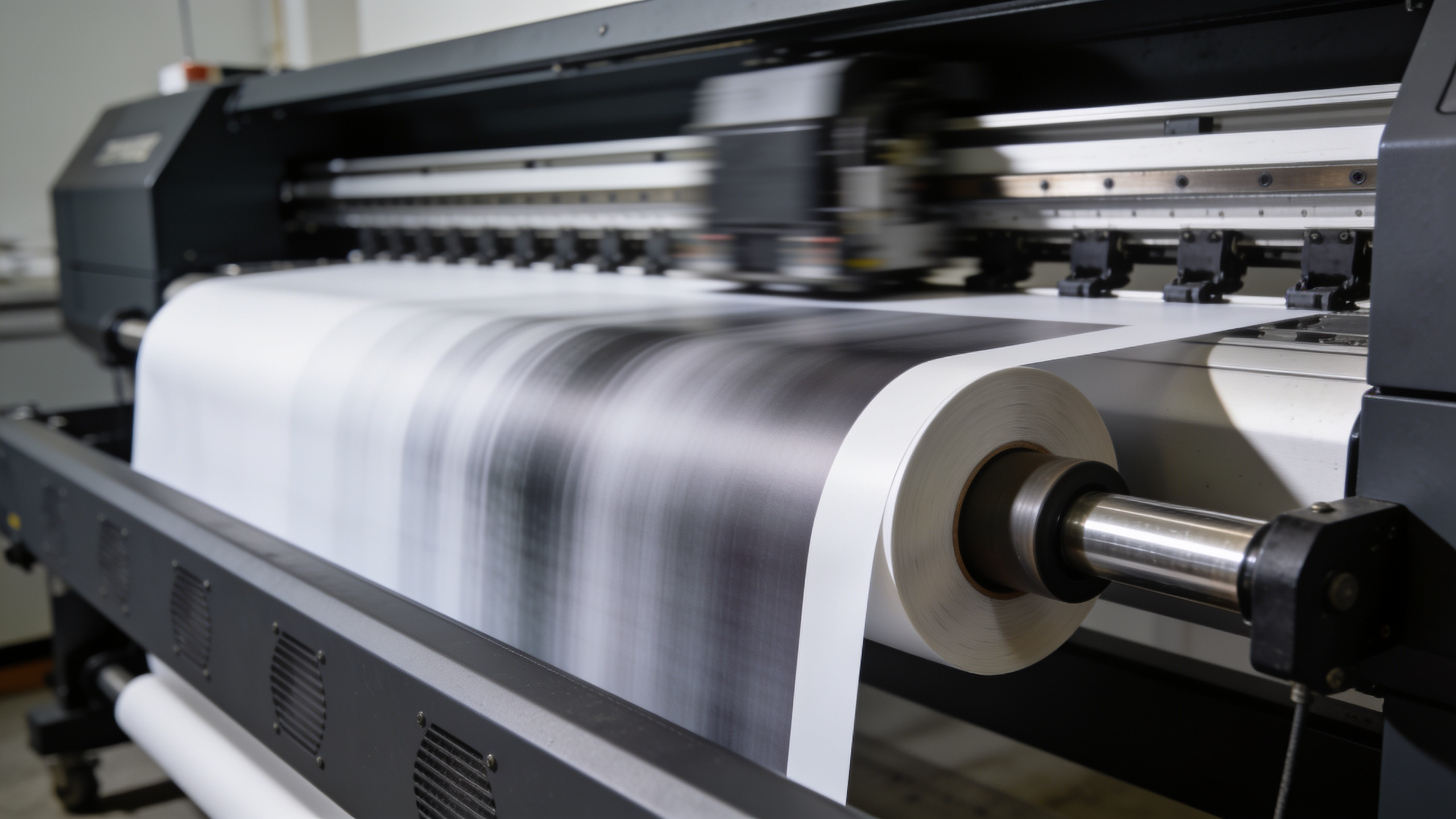
A van sitting in traffic on the 403 is seen by more people in a week than most small business websites see in a year. The question is never whether to put something on it. The question is how much of it to cover, and the answer depends less on budget than people assume.
| Option | Coverage | Typical installed cost | Expected life |
|---|---|---|---|
| Cut vinyl lettering | Name, number, website, a logo | $350 – $900 | 5 – 7 years |
| Partial wrap | Roughly 25 – 60% of the panels | $1,200 – $2,800 | 5 – 7 years |
| Full wrap | Every painted panel | $3,000 – $6,000 | 5 – 7 years |
| Full wrap, cargo van | Every panel on a larger body | $4,500 – $8,000 | 5 – 7 years |
Cut vinyl lettering
Cut lettering is exactly what it sounds like: your name, number, website and logo cut from coloured vinyl on a plotter and applied directly to the paint. There is no background — the vehicle's own colour is the background.
It works best on white and light-coloured vehicles, which is convenient, because most commercial vans are white. On a white Transit, black or dark-blue lettering with one accent colour reads cleanly at 40km/h from two lanes over, which is the only test that matters.
What it is good at: cost, legibility and reversibility. It is the cheapest option by a wide margin, it takes a day rather than several, and when the vehicle is sold the vinyl comes off and the paint underneath is unmarked.
What it cannot do: photographs, gradients, or covering a colour you do not want. If the van is bright red and your brand is not, lettering will not save you.
Partial wrap
A partial wrap covers a portion of the panels — typically the lower two-thirds, the rear doors and a section of the sides — with printed film, and leaves the rest of the paint showing. Done well, the design uses the vehicle's own colour as a deliberate element rather than as a gap.
This is the option most trades should look at first. It buys you photographic capability and a designed presence for roughly a third of a full wrap, and on a white vehicle the uncovered areas read as intentional.
The failure mode is a partial wrap designed as a full wrap with bits missing. The transition between film and paint needs to fall on a panel line, a body crease or a deliberate diagonal — not in the middle of a flat door.
Full wrap
A full wrap covers every painted panel. It is the only option if you want to change the vehicle's colour, run a photographic background, or cover a base colour that fights your brand.
It is also the most demanding to install. Film has to be stretched into recesses, worked over rivets and corrugations, tucked behind door seals and post-heated so it stays there. A full wrap on a cargo van is two installers for the better part of two days. That labour, not the film, is most of what you are paying for.
The film grade matters more than the price
This is where quotes diverge and where the cheap one usually reveals itself.
| Film | How it is made | Conforms to curves | Rated life (vertical, Ontario) |
|---|---|---|---|
| Cast | Poured as a liquid, no built-in tension | Yes — rivets, corrugations, deep recesses | 7 – 10 years |
| Calendered, premium | Rolled under heat and pressure | Gentle curves only | 5 – 7 years |
| Calendered, economy | Rolled, thicker, more tension | Flat panels only | 3 – 5 years |
Cast film is poured as a liquid and cured without tension. It has no memory, so it goes into a recess and stays there. Calendered film is squeezed through rollers under heat and pressure, which leaves internal stress — over time it tries to return to its original shape, which is what lifts edges and pulls film out of channels.
For flat panels and simple lettering, premium calendered is perfectly sound and saves money honestly. For anything with rivets, corrugations, deep recesses or compound curves — which is most vans — cast is the only correct answer, and a quote that does not say which film it includes is a quote you cannot compare.
Ask two things of every wrap quote: which film, and is there a laminate? An overlaminate is a clear film over the print that carries the UV inhibitors. Without it, a printed wrap in Ontario sun fades years before the vinyl fails.
What actually shortens the life of a wrap
- Automatic car washes. The brushes catch edges. Hand wash, or touchless.
- Pressure washers held close. Keep the nozzle 30cm back and off the seams.
- Parking outside, permanently, facing south. UV is what kills film. A vehicle garaged overnight measurably outlasts one that is not.
- Applying over failing paint. Vinyl bonds to what is under it. If the clear coat is peeling, the wrap takes it off when it comes away.
Which one to pick
Choose lettering if the vehicle is already a light colour, the message is a name and a number, and the vehicle may be resold within a few years.
Choose a partial wrap if you want a designed presence and photographic elements, and the base colour is workable. For most GTA trades, this is the value pick.
Choose a full wrap if the base colour is wrong, the design needs edge-to-edge imagery, or the vehicle is the single biggest thing your marketing does.
One thing that applies to all three: put the phone number on the back. Most of the people who read your vehicle are behind it.
Getting it done in the GTA
We design, print and install in-house, which means the person who built the file is the person who knows how it has to sit on the panel.
- Vehicle graphics in Mississauga — install, timelines and what we need from you
- Signage in Brampton, Toronto and Vaughan
- Printing and signage — the full large-format catalogue
- Packages and pricing — Full Surge at $6,999 includes vehicle lettering for one vehicle
Send us the year, make, model and body style and we will come back with a real number. Start here.